


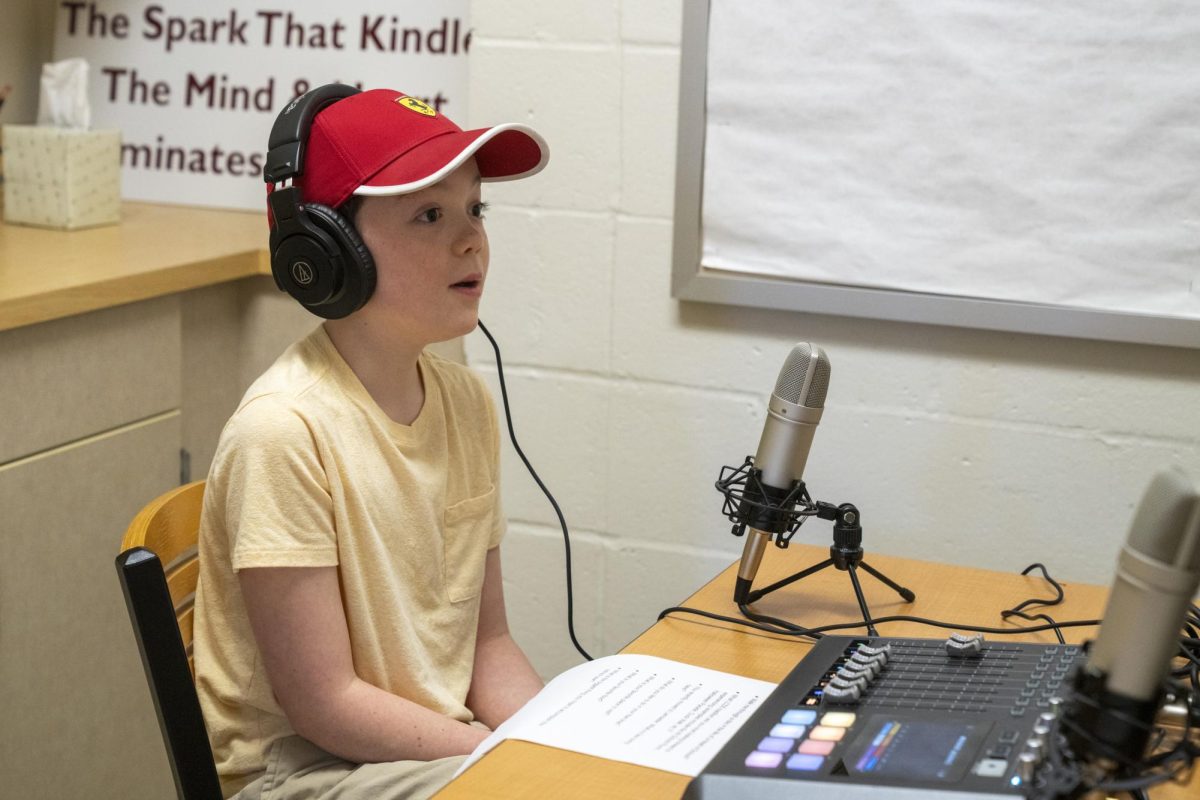

Charlie T. is a current seventh grader and the founder of the first LCDS podcast, “The Rose Report.” Charlie has attended LCDS for 11 years and is heavily involved in the school’s tech departments. Along with running the podcast, he helps with audio and lighting for theatre productions and participates in robotics.
Charlie first found his interest in tech by going to plays and concerts when he was younger.
“I would spend just as much time looking at the sound consoles as I would watching the concert,” Charlie said.
Charlie’s original idea for creating a podcast stemmed from a conversation with Mrs. Wilikofsky, a former middle school art teacher at LCDS. The two were discussing Charlie’s interest in technology and audio when she suggested the idea. Mrs. Wilikofski had previously supervised a middle school podcast club last year, but because she was retiring, she thought Charlie would be interested in continuing something similar.
“I had never really considered it but I do like listening to them,” Charlie said.
Charlie’s first episode was released in early August and since then he has published seven episodes.
“The Rose Report” is a school focused podcast where faculty and staff members are interviewed. In previous episodes, Charlie has interviewed P.E. teacher Mr. Phipps and Head of School Mrs. Kosoff.
Charlie finds that he builds connections with the school community through his episodes. “It’s really interesting interviewing teachers and learning more about them,” Charlie said.
Charlie works very closely with Mr. Schultz, who serves as the podcast’s faculty proctor. Mr. Schultz is also the director of enrollment at LCDS and the upper school boys basketball coach.
“I really don’t do a lot – Charlie is running the whole production,” Mr. Schultz said. “I’m there to be more of a sounding board than anything else. I mainly view my job with ‘The Rose Report’ as supportive.”
Among Charlie’s team is seventh grader Ayaan P., who also helps with the podcast.
“He will run interviews, and I will run interviews,” Charlie said. “He’ll come up with questions for his interviews, and I will come up with questions for my interviews.”
A lot of time, effort, and moving parts go into curating a single episode.
“We come up with questions and bounce things off of each other, and once we have a good list of questions we will figure out scheduling with whoever we are interviewing,” Charlie said. “We then record, and cut things and then compile them all together.”
One of the things that surprised Mr. Schultz most was how much time editing takes compared to the interview itself.
“The part that takes the least amount of time is the interview itself,” Mr. Schultz said. “Editing, mixing, creating intros and outros – those take more time than I thought they would take.”
Charlie does most of the editing himself using GarageBand.
“I have experience using this program at home for quite a while, so I didn’t have to learn anything new as far as learning how to edit goes,” Charlie said.
Although Charlie had had previous experience, Mr. Shultz said he had “zero podcasting experience.”
It usually takes Charlie and his team a couple of weeks and several editing sessions to complete one episode.
“During the winter, I coach basketball, so most of my time after school is taken,” Schultz said. “Charlie and Ayaan are involved with so many activities at the school. We try to plan out a week or two in advance of when we can meet.”
To help solve that issue, Charlie hopes to add more members to increase efficiency and produce more episodes.
Charlie also has ideas for organizing the podcast in the future.
“Eventually it would be great if we could propose the idea of making it [the podcast] an elective, because that would give it a designated time every cycle,” Charlie said.
Charlie also suggested using Google Forms to allow more students to participate in creating episodes.
“Lets say somebody wants to make a podcast interviewing somebody,” Charlie said. “Here’s a google form, you go in and submit your idea. Me or Mr. Shultz could select a few that we think would be good ideas, and then you could gather equipment, do your interview, edit, and then we could post it.”
Charlie’s podcast has opened many opportunities for him. He has been able to share the podcast with visitors touring the school and practice communication skills through speech classes offered in seventh grade.
Charlie and Mr. Shultz hope to expand “The Rose Report” by including more students throughout the school who can help delegate the workload. Charlie also hopes to create a set meeting time during the school schedule or after school to make the podcast more efficient and organized.
Students, faculty and families can find Charlie’s podcast on Spotify, the LCDS Instagram page or in middle school updates sent out by Mrs. Reed.