

Lancaster Country Day, like many schools, is no stranger to travel courses. Spanish Civilization & Culture, Global Issues (where students participate in the Model United Nations), and the Science of Hawaii all offer opportunities to visit other countries or states during the school year after learning enough of the curriculum. These classes rotate every two years, and this year students traveled to Hawaii over spring break.
The Science of Hawaii is a class taught by Upper and Middle School Science Teacher Mr. Bushong. He and another biology teacher founded the class in 2010, which he said was a result of the “push to have travel for our curriculum.”
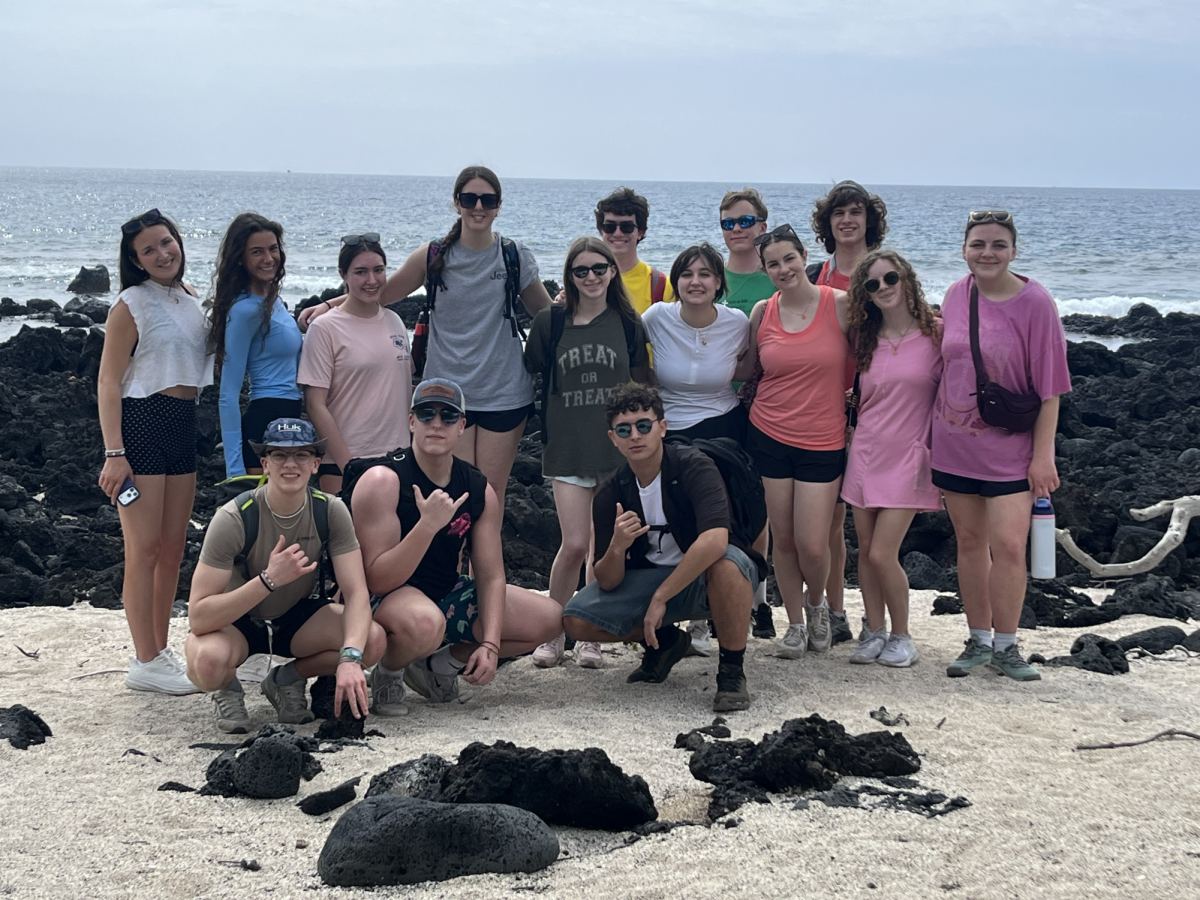
15 students visited Kailua-Kona on the Island of Hawai’i, also known as The Big Island.
Junior Emmie A. described the airport as “open-walled” and “outdoors,” which interested her as it was the first time she’d seen an airport like this.
On the island itself, students visited many local food spots. Emmie and her group frequented a bento place. As a snack, they ate shaved ice from Gecko Girlz, an authentic dessert shop in Hawaii.
Specifically, all students went to a luau. It is defined as a Hawaiian feast accompanied by entertainment, and it is popular among tourists.
There were several phases of entertainment in the luau. Junior Anna S. recalled watching a fire breather while she ate parts of a roasted, unburied pig.
“It had seven acts, and the fire breather was the last one. He had two sticks with fire, and then he would light the fire, and pull it around underneath his legs,” Anna said.
Students didn’t always go out to eat. They sometimes would come back from Costco to take turns making a family style dinner for everyone else.
Julian C., a senior, talked more about this dinner, “We had three vans, and each van had a chance to cook. So we cooked burgers, chicken, veggie burgers. It was definitely more like a family trip.”
During a night swim, students saw 12 types of indigenous manta rays. Snorkeling allowed them to identify various fish living in the reefs.
“We [learned] about choral bleaching events [in class], and you could see that every time we went snorkeling.” said Anna. “We did a project called ‘mapping the sea floor, where we would make structures out of clay, and then determine the depth of the sea floor. The trip reminded me of that lesson.”
Mr. Bushong said recent storms affected conditions. “The waves were coming in more, and it was turning up the sediment on the bottom [which] didn’t make it good to snorkel,” he said.
A special part about the trip was the sighting of a 500 pound Hawaiian monk seal. “It was rare because they are endangered,” said Emmie. “This [was] the first time in Science of Hawaii history [they’d] seen one.”
Some other animals they encountered were wild chickens, goats, and even a pig that lived outside of their house.
The wildlife isn’t all there is to Hawaii, because the state is well known for its volcanoes and geography. In fact, a few people mentioned that the volcano erupted less than 48 hours after they had flown out.
Before leaving, the class hiked through a crater in the Volcanoes National Park, which Anna called “the coolest thing that [she’d] ever seen.”
“The myth is that the nature god Pele watches over the volcano… so if you take anything, she could curse you,” Anna said.
On the hike, students saw molten rocks and plants that only grow in lava. Inside the crater, it was surprisingly raining because of the difference in climate compared to areas outside the crater.
“In past trips, it was neat to see the volcano erupting and flowing into the ocean,” said Mr. Bushong. “One trip we took, it was coming out along the side of the mountain. We hiked numerous miles to see lava flowing.”
Hiking is a major part of the Science of Hawaii trips.
“We were in the middle of the mountains… in some sort of jungle on a main road,” Julian recounts, “[I] went down [the cave] and there were steep steps. It was dark and slippery, and lowkey creepy but we survived.”
By the time the class flew home, it was already nearing the end of spring break, so they took an extra day off to get their bearings. Overall, it was an unforgettable experience for many.
Anna talked about how her desire to enter Science of Hawaii started in seventh grade. She and her friends had been wanting this for years, so it was satisfying for this long plan to come into fruition.
“Honestly, I think I should just give up everything and just live there,” Julian said, “I would definitely recommend going if you have not.”
Science of Hawaii will not be offered next year, but it is expected to return in the 2027-’28 school year for juniors and seniors.