














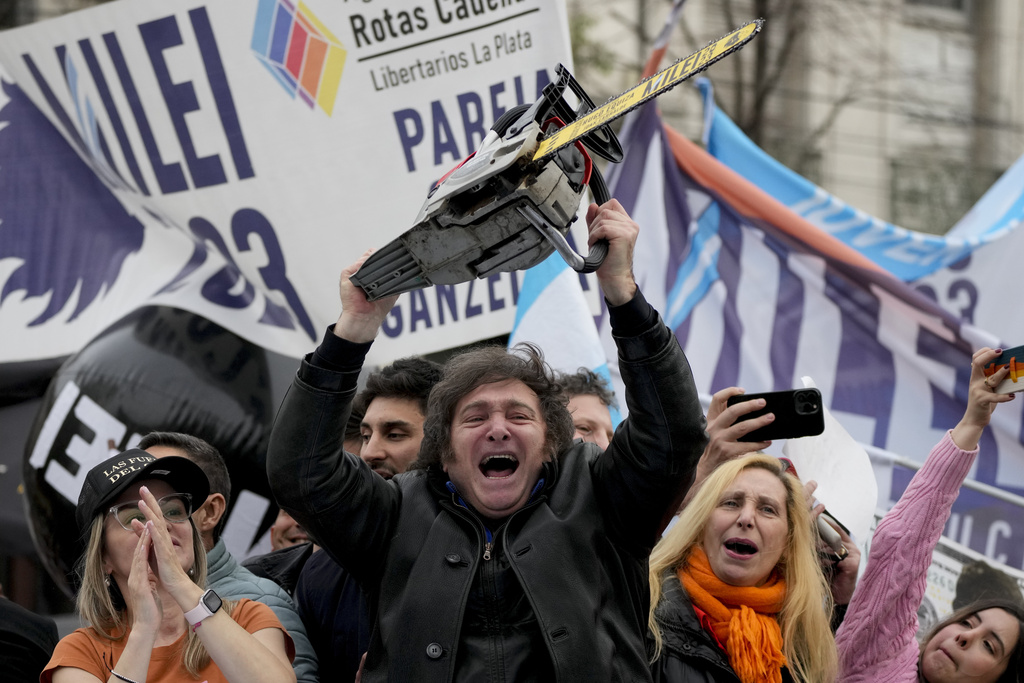
After years of economic stagnation, President Javier Milei of the right-wing La Libertad Avanza has shaken up the Argentine economy during his first two years in office.
Milei has drawn international attention for a currency-swap deal with U.S. President Donald Trump and remains popular in many conservative and libertarian circles.
Milei, then a national deputy in Argentina’s Chamber of Deputies, announced his presidential campaign in 2022. After winning the La Libertad Avanza primary, he quickly gained momentum in the general election due to voter frustration over massive inflation.
“Data released Tuesday showed annual inflation surpassed 100 percent for the first time since the early 1990s, bringing back memories of the hyperinflation that ravaged South America’s second-largest economy,” Patrick Gillespie wrote for Bloomberg in 2023. “Milei’s real bonus is that neither of the established blocs, populist or pro-market, has been able to fix an economy lurching deeper into the abyss.”
He ran on a strongly libertarian economic platform. His proposals included eliminating the Central Bank, dollarizing the Argentine economy, cutting the ministries of education, health and public works, lowering taxes, and deregulating markets.
Milei’s campaign was characterized by his carrying of a chainsaw, which he carried to represent his self-described “chainsaw economics” system – one that promised the slashing of government spending across the board.
“[The chainsaw is] a very explicit representation of what everyone feels, which is that the [Argentinian] government is overflowing with people who, in general, don’t fulfill any function,” Mariel Fornoni, social director of Management and Fit, a political consultancy group, told the Associated Press.
Analysts have described him as Argentina’s version of Donald Trump because of his bombastic personality, anti-establishment rhetoric, and opposition to gun control and regulation.
”He is quite literally a mini-Trump,” Federico Finchelstein, chair of the history department at The New School in New York, told The New York Times.
One hundred and eight economists penned an open letter published in The Guardian, claiming that a Milei Administration would cause economic “devastation in the real world in the short run” and severely reduce “policy space in the long run.”
Milei won the November 2023 Argentine presidential election with 55.65-percent of the vote, defeating Peronist Candidate Sergio Massa.
Since taking office, Milei has implemented sweeping reforms aligned with his “chainsaw economics.” Government spending was central to his campaign. Since taking office, he has reduced it by 30-percent in 2024.
Before Milei took office, Argentina had 18 government ministries. He eliminated ten ministries and more than 200 lower-level departments, contributing to the spending cuts.
On deregulation, Milei’s stance has been clear. Soon after taking office in December 2023, he repealed national rent control laws that capped how much landlords could charge. He also shifted to post-market inspection of businesses rather than inspecting them before they entered the market. He believes that this measure will reduce red tape while preserving consumer protections.
Milei’s approach to deregulation is more aggressive than that of many world leaders.
“Using a conservative methodology, my colleague Guillermina Sutter Schneider and I calculated that during Milei’s first year in office, he implemented about two deregulations per day,” wrote Ian Vasquez, director of the Cato Institute’s Center for Global Liberty and Prosperity. “Roughly half of the measures eliminated regulations altogether, while the rest modified existing regulations in a generally market-oriented direction.”
Milei has also pursued global trade reforms, such as abolishing the PAIS tax. Argentina enacted the Tax for an Inclusive and Solidary Argentina, known as the PAIS tax, in 2019. The tax aimed to protect domestic Argentine businesses.
“[It] is a cost disguised as a levy that residents of the country must pay when engaging in foreign currency transactions,” Argentine law firm WSC Legal wrote. “However, despite its name, it is not a conventional tax. Conceptually, it operates as a surcharge on foreign exchange transactions, which results in a higher exchange rate for purchases made in pesos.”
Milei abolished the tax in December 2024.
“You have enjoyed the favor that the Argentine people as a whole gave you in subsidies, exemptions, and tariffs on the competition,” Milei said after repealing the tax. “You had decades of hunting in the zoo, protected by the story of preparing the productive matrix and business model to be able to compete on your own terms.”
He has also taken further steps to liberalize imports, like abolishing import licenses that supporters say imposed additional costs.
However, he has not fulfilled all of his campaign promises. Despite originally running on vows to abolish the Central Bank and dollarize the economy, he has not yet done so. He has also struggled to make reforms permanent because his party, La Libertad Avanza, holds only eight of the Argentine Senate’s 72 seats.
Milei inherited a volatile economy.
“Twenty years mostly ruled by the populist Peronist party of the left had produced 42 percent poverty, yearly inflation of 211 percent, a quasi-fiscal deficit of 15 percent of GDP, massive public debt, an effectively bankrupt central bank, and an economy that had stagnated for a dozen years and was now in free fall,” Vasquez wrote. “Argentina was heading toward hyperinflation, debt default, and complete economic collapse.”
Before Milei took office, Argentina’s housing market was suffering. Rent was becoming unaffordable for many.
The Rio Times reported that rents in the city of Buenos Aires had increased more than 120-percent in one year, citing a study from the Scalabrini Ortiz Center for Economic and Social Studies.
Critics blamed Argentina’s 2020 rent control law, which imposed strict limits on renters.
“The 2020 Rental Law, enacted under former President Alberto Fernández, aimed to protect tenants,” Katarina Hall reported for Reason Magazine. “It mandated three-year lease terms and required rent to be paid in pesos—a currency rapidly losing value due to rampant inflation. Rent adjustments were limited to once a year, based on a central bank rate that factored in inflation and wage growth. The law also allowed tenants to dictate the conditions for lease termination.”
After taking office, Milei repealed national rent control laws. Supporters argued this removed costly barriers for many landlords and provided more incentive for them to put up properties for rent.
Hall reported that, based on data from Mercado Libre and the Universidad de San Andrés, rental housing supply in the Buenos Aires metropolitan area was 212 percent higher in June 2024 than in December 2023.
Government data show that from 2019 to early 2024, the average monthly rent for a two-bedroom apartment rose from 18,000 pesos to 334,000 pesos, outpacing inflation during that period.
In the first seven months after the repeal, rents fell 27-percent, as competition among landlords increased.
“While rents are still up in nominal terms, many renters are getting better deals than ever, with a 40 percent decline in the real price of rental properties when adjusted for inflation since last October,” Economist Frederick González Rouco of the Argentine firm Empiria Consultores told The Wall Street Journal.
Inflation dominated the 2023 election. In Milei’s first month in office, inflation reached 25.5-percent after he devalued the peso by 52-percent in an effort to stabilize the economy. Milei’s de-regulatory measures, trade liberalization, and spending cuts have correlated with a notable decrease in inflation.
“By November 2024, [inflation] had fallen to its lowest level in over four years,” France 24 reported.
Poverty rates have also shifted. Argentina’s poverty rate fell to 31.6-percent in the first half of the year, according to the INDEC national statistics bureau, as reported by the Buenos Aires Times. That marked a 6.5-point drop from the second half of 2024.
Not everything seems to be improving. As noted earlier, Milei has not been able to implement all the reforms he promised, and homelessness and poverty have risen during parts of his tenure.
“[During his administration,] more than 200,000 formal jobs have been lost,” Tiago Rogero said in The Guardian.