







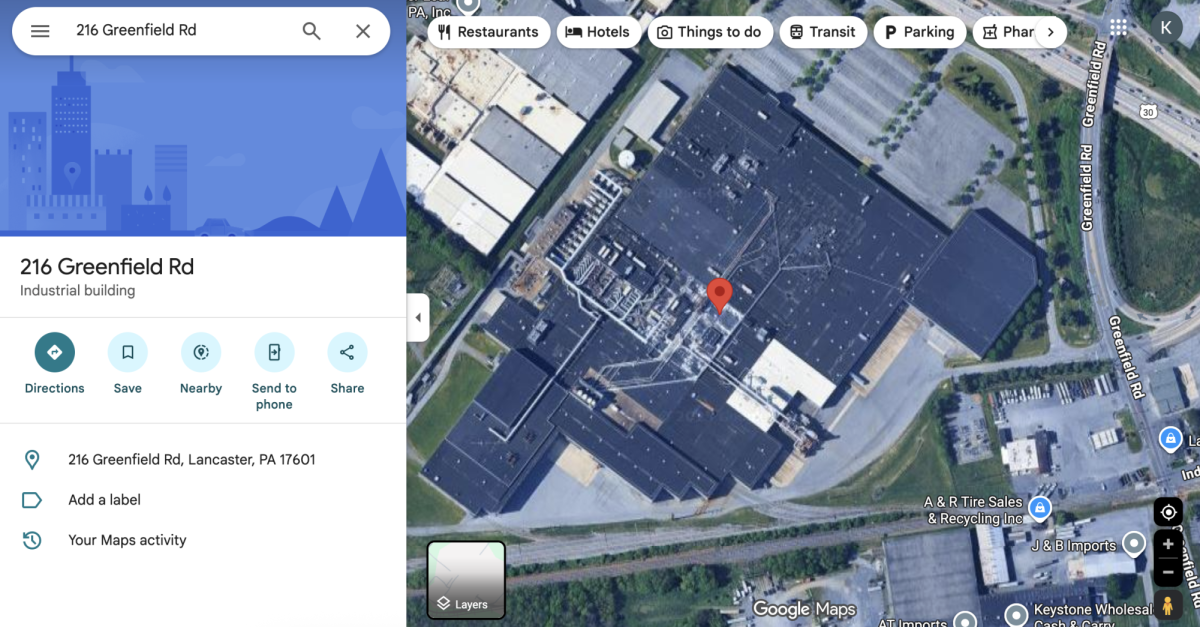
Two Artificial Intelligence data centers could make their way to Lancaster, Pennsylvania. These projects have accumulated unfathomable prices, and have struck fear in the hearts of locals. It’s time for people in Lancaster to act against these data centers near our neighborhoods.
Lancaster Stands Up, a progressive Lancaster City organization, looks to appeal the ruling that’s allowing further advancements to these data centers. The group held a community event on Thursday, October 23, 2025 where community members and organization members voiced their concerns surrounding these data centers.
Frank Arcoleo is a member of the Lancaster Stands Up and is leading this appeal process in opposition of the data centers. His main point of emphasis being the lack of support from our government officials.
During Frank’s final discussion point of the night he said, “This isn’t a fight between the left and right, but between the top and bottom.”
Lancaster Stands Up created a new Community Benefits Agreements (CBA) that they plan to bring to the Lancaster City Council. The document proposes more regulation regarding noise pollution, environmental implications, and energy usage.
Community members expressed dissatisfaction with the current CBA, which was presented by the City of Lancaster. Many of them agreeing the Lancaster Stands Up CBA is primarily focused on harm reduction instead of outright policy change
Sarah Berman, community member and discussion participant said, “This entire project is a huge investment, with little benefits. I’m fearful these policies won’t do enough to stop [the data centers].”
Zoning remains a key problem. Simply put, zoning consists of local laws that dictate how land and buildings can be used in towns, counties, or cities. Zoning determines a building’s classification, whether it’s a warehouse, store, factory, school, etc.
In the case of these Lancaster AI data centers, Lancaster City Zoning Officer Jameel Thrash, and developers had meetings regarding the data centers as early as September 2024. These zoning conversations were private and had no community input, which is quite uncommon for such a huge project.
In February of 2025, Thrash concluded the data centers will be classified as a wholesale trade and storage building, also known as a warehouse. Because of local laws, warehouses are allowed at the proposed locations and there was no requirement to inform the public.
Leading to community members to only find out about this proposed construction after it was too late to give their input on this situation.
These two data centers will allegedly use 100 megawatts (MW) – 300MW of energy. To put that into perspective, 1 MW could be used to power around 160 homes. This is an immense amount of energy exertion, and unfortunately, most of this energy is non renewable.
Diesel generators are presented as another source of energy. According to World Wide Power Products, diesel generators are great for lower maintenance costs, fuel saving, and extended lifespan but they produce a vast amount of noise pollution.
A small diesel generator can produce 85 decibels of noise, similar to the amount of noise you’ll hear in a busy city during rush hour. Federal law prevents more than 100 hours of diesel generator usage per year, but when the diesel generators are on, the sound will blare through the neighboring houses.
PJM Interconnection is a grid operator that provides around 25% of the power supply in the Eastern and Midwestern United States.
The environmental implications seemed to also not be considered before the authorization of this project.
In the current CBA regarding the data centers, it says, “The Greenfield Road site will primarily use air-cooled chillers, not water, for cooling purposes.”
Air cooling systems in data centers can account for 40% of the center’s energy usage.
Let’s be realistic: skepticism towards AI has assimilated throughout the world. Over these past couple of years, Artificial Intelligence has become economically intertwined with American culture.
Data from the Stanford University Human-Centered AI confirm this belief, “U.S. private AI investment grew to $109.1 billion” and added, “Generative AI saw particularly strong momentum, attracting $33.9 billion globally in private investment.”
To comprehend the prevalence of AI in our economy, one must observe the stock market.
What we’re witnessing right now is the unsettling formation of an economic bubble; a period of massive, concentrated price increases within a single sector. In this case, that sector is artificial intelligence.
As data centers pop up around America, we must band together and restrict their residence in our city.