








On August 20, Upper School students were informed of new restrictions on cell phones in school during the first meeting after coming back from summer. The new rules were created in conjunction with the Upper School administration and Upper School StuGo over the summer.
These policies have been met with varying reactions.
“I think taking our phones away for just carrying them in our pockets is not what is going to [achieve] the goal of us not being as distracted by our phones,” Senior Benedikt K. said.
Many students said they were surprised after the announcement, as policies are more strict than in previous years.
The Policies
Last year, Upper School phone policies allowed students to carry their phones in their pockets at all times. Teachers could set their own rules on if they wanted students to put their phones in a “phone hotel” or if students could keep their phones in their pockets. Now, the rules require that phones are kept in either a student’s backpack or locker during class time and in hallways, marking a change from last year.
Middle School Administrative Assistant Darren Hamric explained the rationale behind a policy like this, saying, “Even [the keeping of cell phones on one’s person] created distractions and opportunities for students to engage in behaviors that were not aligned with our vision, mission, and values.”
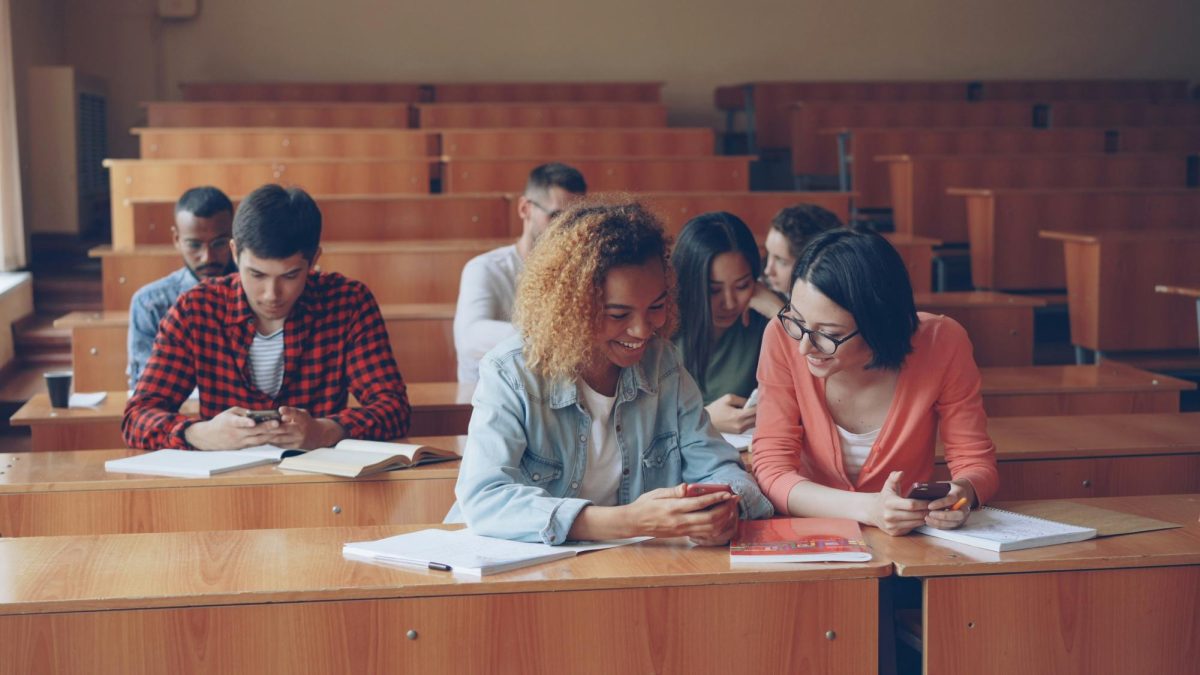
Many students have been impacted by this change, as a common practice was to either hold their phone in their hands or keep them in their pockets while walking from class to class; this is no longer the case. If a student needs to call their parents, they must now go to the Upper School office and call them from there.
“I do feel that being able to be in contact with your parents is very important,” Junior Michael C. said.
The policy has been slightly controversial among the general student body, with some saying it’s necessary to keep people off their phones for a better school environment while others argue that it just serves to infantilize students.
“We’re not little kids anymore, we’re Upper Schoolers,” Michael said. “So it would make sense that we should be able to contact our parents ourselves.”
Last year, during office hours and study hall, students could technically be on their phones for the entirety of a study hall, provided they had no pending work. This is no longer the case, as phone usage during those periods is now limited to listening to music or for brief tasks only.
This has been a point of contention for many students.
Benedikt said, “I think it’s pretty unnecessary. If it’s Monday, you’re a responsible student, you did all your homework over the weekend and now you have no homework to do, they just expect you to sit around in study hall and do nothing because you’re not supposed to play games or anything.”
For students, there is no more watching Netflix in study halls.
The Meeting Clause is not a new policy. During spring last school year, the usage of phones before Upper School meeting was banned. Some students had their phones confiscated because of this. This rule returned this year, along with the broader range of restrictions on phones.
The Enforcement Clause now states that students using their phones without permission will have their phones confiscated until 3:00 p.m. Last year, confiscation for a full day was rare, with many teachers having their own policies and methods of dealing with students who used phones in their classes. This marks a notable shift in the enforcement of these rules.
The LCDS Perspective
Michael said, “[The new phone policies are not] an enormous change from the old ones but there’s definitely some stuff that’s different.”
This is a sentiment reflected in the greater Country Day community’s reactions. Sixty-six people in the LCDS community (as of 9:05 p.m. on September 17) responded to a survey (including five faculty, nine Freshmen, 16 Sophomores, 18 Juniors, and 18 Seniors) asking for their thoughts on the new phone policies.
The survey found that 12.1-percent of people strongly approve of the new phone policies, 21.2-percent approve, 33.3-percent disapprove, 7.6-percent strongly disapprove, and 25.8-percent are neutral towards them.
It is important to note, however, that five faculty members – who all expressed approval – were also included in the polls and are less affected by the new policies. When taking into account just the student body, a clearer trend emerges: 8.2-percent of students strongly approved of the new phone policies, 19.7-percent approved, 36.1-percent disapproved, 8.2-percent strongly disapproved, and 27.9-percent are neutral towards them.
Faculty and Freshmen were the groups most likely to express approval of the new policies, while Sophomores were the most likely to disapprove.
“The presence of cell phones can be a very big distraction for students in class and outside of class. It can impede the development of community, especially outside of class times, like lunch or study halls and things like that,” Mr. Hamric said. “Minimizing opportunities for students to engage in cell phone use has shown to really promote academic success, as well as social and emotional success.”
“In my opinion, I like the fact that we’re able to even be on our phones at all during school,” says Freshman Sia S. (and the reporter’s younger sister). “But that might just be left over from [our] lack of ability from Middle School.”
The National Perspective
The enshrinement of these policies is not an isolated instance in regards to cell phone policies in schools. The presence of cell phones in schools has become a national debate, mainly due to many teachers stating that students are being distracted by cell phones.
“About seven-in-ten (72%) [of teachers] say that students being distracted by cellphones is a major problem in their classroom,” according to Pew Research, “compared with 33% of middle school teachers and 6% of elementary school teachers.”
Some states are passing laws restricting how cell phones are used in classes – 34 states so far. In fact, 24 states have legislation (except for Oregon and Virginia, which have executive orders) banning the use of cell phones in classrooms and schools; the goal is to promote and increase the academic performances of students.
Researchers from Washington State University found that, “[T]he greater the use of a phone while studying, the greater the negative impact on learning and academic achievement. Additionally, the results suggest that skills and cognitive abilities needed for students’ academic success and learning are negatively impacted.”
There is an opposition that exists to these blanket bans; many advocates for not banning cell phones in schools argue that banning phones actually hurts students by failing to teach them how to deal with these distractions or teach them responsible phone usage.
“The far better approach is to make sure you create a culture in your school of healthy tech use,” CEO of the International Society for Technology in Education Richard Culatta said in an interview with The Hill. “Nobody on the planet would tell me that healthy tech skills aren’t needed for future jobs and future life happiness, right? So then why on Earth would we not be teaching those skills that we know are so important?”
Currently Pennsylvania does not have any laws regarding the usage of cell phones in schools, but Pennsylvania House Bill 1814 would ban the carrying of cell phones in public schools.